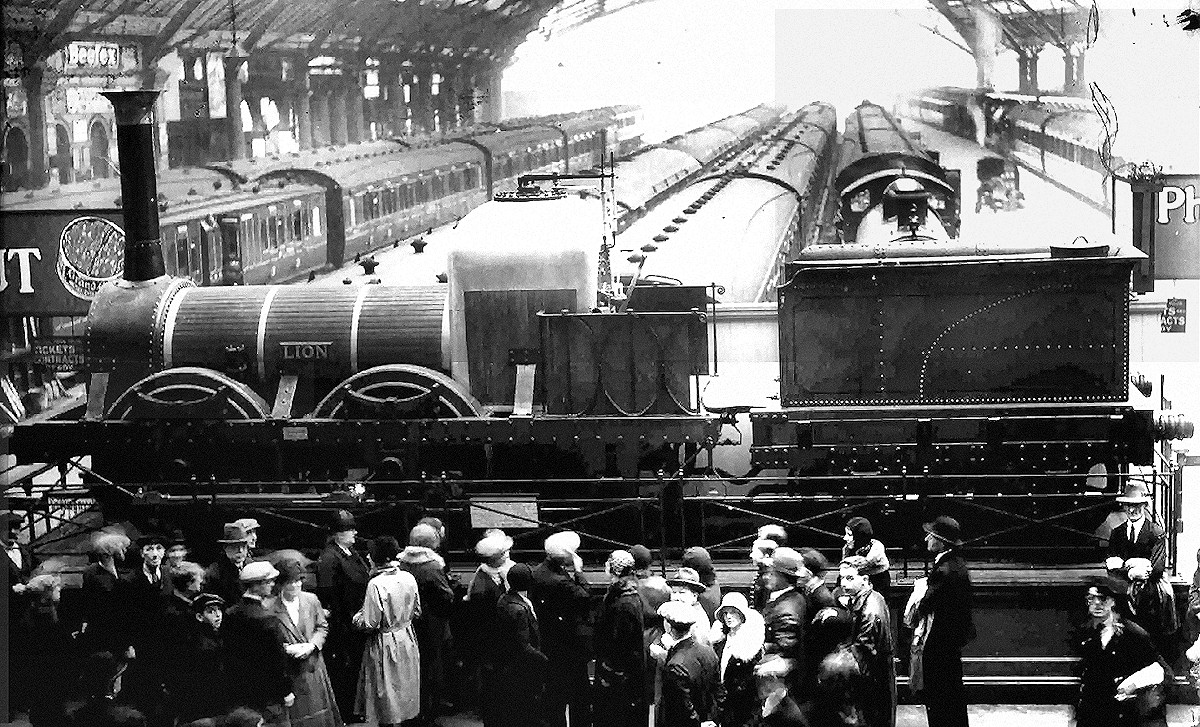
'Perhaps the most interesting
feature of the Liverpool and Manchester Railway Centenary Celebrations,
held at Liverpool from September 13th, was the "Train of 1830" drawn by
the reconstructed "Lion", which carried passengers round a circular
railway specially laid down at the Wavertree ground.
According to Wishaw, this locomotive was built for the Liverpool and
Manchester Railway in 1838 by Messrs. Todd and Co. It now appears that
the company consisted of Charles Todd, James Kitson and a Laird, and
that they began manufacturing early in 1838. In 1839 Kitson and Laird
withdrew and started a new firm, which has developed into the present
Kitson and Co., while Todd continued the original business with a new
partner under the title Shepherd and Todd of the Railway Foundry. After
1846 the foundry was carried on by E. B. Wilson and was eventually
acquired by Messrs. Manning, Wardle and Co.
Two engines, the "Lion" and the "Tiger," were built at about the same
time; the "Lion" is believed to have been delivered in July, 1838, and
both were at work before October of that year. Edward Woods, the
company’s engineer at that time, when sending out a specification for
new boilers, quoted these engines as examples to be followed as regards
materials and workmanship. The "Lion" was No. 57 on the company’s list
and was taken over, with other stock, by the Grand Junction Railway in
August 1845. In 1846, when the London and North-Western Railway was
formed by further amalgamation, it became No. 116 of that line.
The "Lion" was sold for the sum of £400 to the Mersey Docks and
Harbour Board on May 26th, 1859, and worked as a pumping engine at
Princes Graving Dock from that date until August 1928, when it was
presented by the Board to the Liverpool Engineering Society, whose
property it remains, in order that it might be preserved for the city of
Liverpool. It has been restored during the present year in the Crewe
shops of the London, Midland and Scottish Railway, with the assistance
of Mr. J. G. H. Warren.
The engine is of the inside cylinder, 0-4-2 type, which was one of
the forms of six-wheeled engine introduced by Robert Stephenson in 1833,
and extensively copied by other engine builders. The cylinders are now
14in. diameter by 18in. stroke, but the figures given by Wishaw in 1840
were 11in. diameter and 20in. stroke. In a list of about 1846, by John
Dewrance, who succeeded Eward Woods, the cylinder diameter is given as
12in. and the stroke as 18in., so that it would appear that the
cylinders were changed for larger sizes ar least twice, but the changes
were no doubt made before the engine ceased work as a locomotive.
The driving wheels are 5ft. diameter and the trailing pair 42in.
diameter. The wheelbase is 12ft., equally divided. The cylinders are
placed low down so that the piston-rods pass below the leading axle with
an upwards inclination of 1 in 13. The valve chests are placed on the
tops of the cylinders, as was then usual, and the valves are driven
through rocking levers, the upper ends of which are connected with the
valve spindles, while their lower ends carry pins with which the
excentric rods engage.
The valve gear is of the four-excentric type, introduced in 1835, in
which, for each cylinder, there is a fixed excentric for each direction
of motion, and the excentric rod ends are provided with notches or gabs
that engage with the pins on the valve levers. The gabs are furnished
with spreading jaws or forks, which enable then to engage with the pins
without the aid of hand levers on the footplate.
The reversing gear is that variety of the forked gab type introduced
about 1840 and usually associated with the name of William Buddicom, who
was Edward Wood’s assistant at the Liverpool end of the line. In this
form the forks of the excentric rods face one another and the rod ends
are linked to levers on a reversing shaft placed below them, so that
both are lowered or raised together, and either the upper or lower gab
is engaged with the pin of the valve lever.
The valves now on the engine have an outside lap of 13/16in. and a
travel of 3 13/16in., the cut-off being 81 per cent. When the engine was
built the valves had little or no lap, but Woods records that all the
Liverpool and Manchester engines were altered or provided with new
cylinders and valves, with lap and longer travel, between 1840 and 1842.
It was probably at that time that the 12in. by 18in. cylinders were
fitted, and very likely the present valve gear as well.
The engine has outside sandwich frames of wood between iron plates,
the axle-box horns being bolted to them. Inside the wheels there are two
wrought frames – extending from the smoke-box to the fire-box – which
carry extra bearings for the crank axle only. The springs for the
coupled axles are mounted above the frames, and those for the trailing
axle below them. The boiler and cylinders are are supported by brackets
from the outside frames. The guide bars are carried at the front end by
the cylinder covers and at the rear end by spectacle plates hanging from
the middle boiler support.
The present boiler is of comparatively late date, somewhat larger
than the original one, and having a very high fire-box crown. It is not
certain what kind of outer fire-box the "Lion" originally had. Liverpool
and Manchester engines of the period usually had a slightly raised
crown, but Kitson and Laird appear to have favoured the haystack form in
their early engines, so that, if they had a free hand in the design of
the "Lion", its fire-box may have had that form. In the reconstruction
the high crown of the existing boiler has been masked by a cover of the
haystack form. Whishaw gives the original boiler dimensions as:- Barrel,
39in. by 42in. and 7.4ft. long; 126 tubes, 1.625in. diameter diameter
and 8ft. long; inner fire-box, 30in. long, 39in. wide and 36in. from
grate to crown. The total heating surface was 460.3 square feet and the
grate area 8.12 square feet. The steam pressure was 50 lb. Per square
inch and the tractive effort at 85 per cent. Boiler pressure is 2499ib.
with the present cylinders. The regulator is within the fire-box crown,
which is surmounted by two lever safety valves loaded by Salter spring
balances; these balances also serve to indicate roughly the steam
pressure. Edward Woods’ boiler specification of October 1838, required a
dome over the firebox with one safety valve, as well as a second dome,
another safety valve on a pillar, and a manhole on the boiler barrel.
The weight of the "Tiger", which was closely like the "Lion", is
given by Whishaw as 14.47 tons; in its present state the "Lion" weighs
18.85 tons.
The four-wheeled tender has been adapted from an early tender from
the Furness Railway, and is very similar to those in use about 1840. The
engine and tender together weigh 26.55 tons, and their overall length is
32.74ft.
The train drawn by the "Lion" consisted of replicas of the first and
second-class coaches of 1830, evidently based on the well-known
Ackermann prints. The first-class coaches were excellent copies of the
reconstructed model of the coach "Experiment", dated from 1834, now
belonging to the L.M.S. Railway; but the second-class vehicles, while
being apparently copied from the Ackermann prints, were incorrect in
that they were seatless. The tickets issued for these were described at
the booking office as "third class" instead of second; third class did
not, of course, exist in 1830.
The "Lion" is to be given a place of honour at Lime-street Station,
Liverpool, over the buffer stops between platforms Nos. 3 and 4'.